BOOK REVIEW
Anne Bruneau (Université de Montréal)
Monographie des Leguminosae de France by Pierre Coulot and Philippe Rabaute
In 1763, Michel Adanson published the first classification of the legumes, initiating a long-standing contribution by French botanists to the knowledge of the legume family. This was followed by Antoine-Laurent de Jussieu, who in 1789 published the name Leguminosae and proposed a classification based on floral structure that served as the foundation for future classifications. French botanists have been contributing to our knowledge of the family since then, from Aimé Bonpland (1773–1858), who accompanied Alexander von Humboldt on his explorations of South America, to more contemporary botanists such as Philippe Guinet (palynologist, 1925–2019), Jean-François Villiers (Mimoseae, 1943–2001), Jacques Vassal (Acacias), René Viguier (1880-1931) and Jean-Noël Labat (1959–2011), who specialised on the legumes of Madagascar, alongside numerous other systematists, ecologists and evolutionary biologists.
Most recently, building on this rich history of French legume research, this year Pierre Coulot and Philippe Rabaute published the last of their four-volume series, Monographie des Leguminosae de France, presenting close to 350 legume species native and naturalised of France. Pharmacists by profession and field biologists by passion, these two scientists and long-term collaborators have explored the country from one end to the other collecting and documenting legume species, reviewed the literature, examined herbarium specimens, and delved into databases to put together this remarkable work on one of the most important angiosperm families of France.
Volume 3 published in 2013, followed by Volume 4 in 2016 and Volume 2 in 2020, all focused on Papilionoideae tribes, the authors now present Volume 1, which describes the Caesalpinioideae and Cercidoideae of France, as well as several Papilionoideae tribes. The last of these volumes to be published, which brings to fruition more than 20 years of detailed work by these two colleagues, begins with an up-to-date and comprehensive summary of the Leguminosae, highlighting the taxonomic knowledge, from the first contributions in the 18^th century to those of contemporary authors, discusses the importance of legumes in the development of agriculture throughout the world and their present-day economic importance, and describes in detail their phytochemical diversity and pharmaceutical importance. The Introduction itself is a source of information that is both accessible to the broader public and invaluable to students of Leguminosae.
For each species, the description is accompanied by photos to highlight its characteristic morphological features for ease of identification. A nomenclatural history, the protologue, a detailed morphological description, as well as the conservation status, etymology, ecology and a distribution map are presented. In addition, for each taxonomic group, the authors have included an identification key to the species, tables of comparative characters, an exhaustive list of species, a recent literature review and a history of the taxonomy. An index to synonyms is included to facilitate searching for names. Notably, Volume 1 presents an identification key to all legumes of France, in itself an impressive feat to be commended.
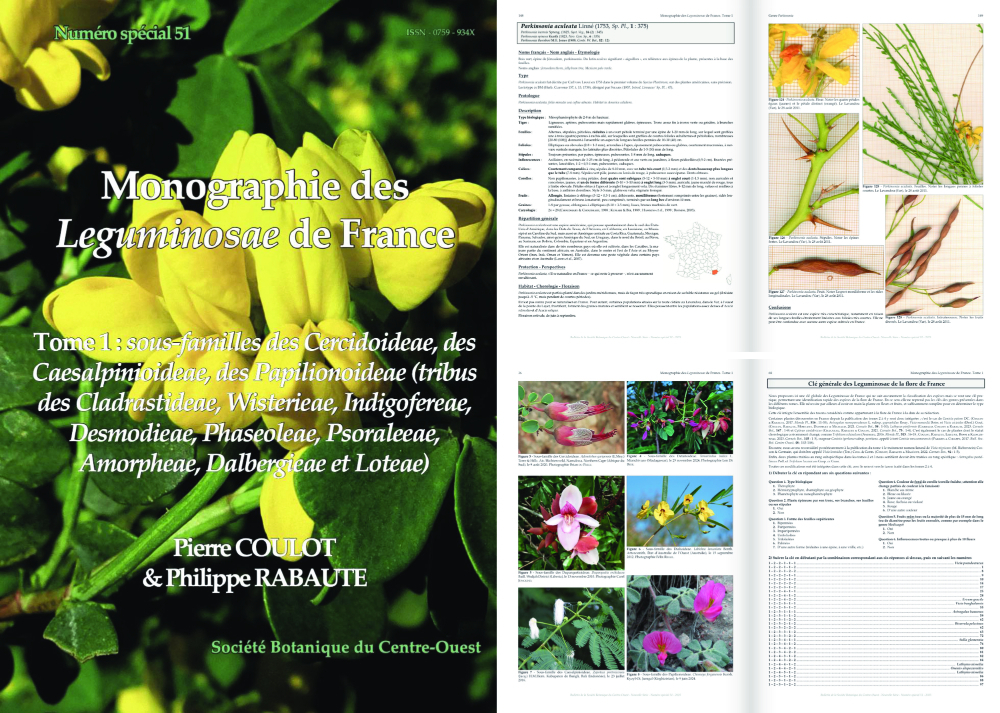 Cover and some pages of Tome 1 of the Monographie des Leguminosae de France.
With this comprehensive, precise and up-to-date Monographie des Leguminosae de France in four volumes, Pierre Coulot and Philippe Rabaute have achieved not only their personal goal of documenting the legumes of France, but also an immensely valuable and massive (over 2800 pages!) contribution to our knowledge of the family. Because France is one of the most climatically and physiographically diverse countries of Europe, spanning Mediterranean, temperate forest and alpine biomes, we have here a compendium of legume diversity, useful not only for France, but for Europe in general. At a time when world biodiversity is in rapid decline and constant change, such high-quality contributions that document local and national biodiversity have a critical role in stimulating our connection to nature and fortifying our commitment to its protection.
Monographie des Leguminosae de France by Pierre Coulot and Philippe Rabaute. Published by the Bulletin de la Société botanique du Centre-Ouest, France.
Tome 1 – Sous-familles des Cercidoideae, des Caesalpinioideae, des Papilionoideae (tribus Cladrastrideae, Wistereae, Indigofereae, Desmodieae, Phaseoleae, Psoraleeae, Amorpheae, Dalbergieae et Loteae). Numéro spécial 51. 2025. 706 pages.
Tome 2 – Robinieae, Sesbanieae, Galegeae, Glycyrrhizeae, Coluteae, Astragaleae, Caraganeae, Hedysareae et Thermopsideae. Numéro spécial 49. 2020. 518 pages.
Tome 3 – Tribu des Trifolieae. Numéro spécial 40. 2013. 760 pages.
Tome 4 – Tribus des Fabeae, des Cicereae et des Genisteae. Numéro spécial 46. 2016. 902 pages.