GALLERY OF LEGUMINOLOGISTS
This year the Gallery of Leguminologists features two pieces. One portrays an American botanist who contributed largely to the knowledge of Equatorian legumes and plants as a whole. The other provides a glimpse on the life of one of the main experts on the ontogeny of legume flowers and inflorescences.
If you would like to portray the life of researchers from other areas of legume taxonomy and biology, please get in touch with the Bean Bag editors. We are looking to highlight botanists who may be less well known to the current generation of the legume community, and leguminologists whose achievements have not always been celebrated elsewhere. Synopses need not be complete biographies but a few images would bring them to life.
David Neill (1953–2025)
Colin Hughes (University of Zurich, Switzerland); Bente Klitgaard (Royal Botanic Gardens Kew, UK) and Anne Bruneau (Université de Montréal, Canada)
David Neill was an American botanist who spent most of his career in Ecuador, living there since 1985, and making pivotal contributions to botanical knowledge, training, and capacity building in that country and more widely in the Neotropics. He published extensively on the neotropical flora and was a world expert on Ecuadorian trees, with an unmatched ability to identify them, and to teach others how to identify them.
David’s botanical collecting started during his time as a Peace Corps volunteer in Nicaragua. He went on to do his PhD at Washington University, defending his thesis entitled Experimental and Ecological Studies on Species Relationships in Erythrina (Leguminosae, Papilionoideae), in 1984, under the supervision of Peter Raven. David’s doctoral research focused especially on experimental studies including crossability, hybridization and pollination among species of Erythrina and resulted in two landmark papers on these topics. Even today, 40 years later, there are very few woody plant genera for which interspecific crossability studies have been undertaken. As part of his PhD, he also spent many months collecting and observing the hummingbird pollinators of Erythrina species in Central America, again a remarkable contribution to our understanding of the pollination biology of tropical arborescent species. Erythrina x neillii Mabb. & Lorence was named for David in recognition of this work.
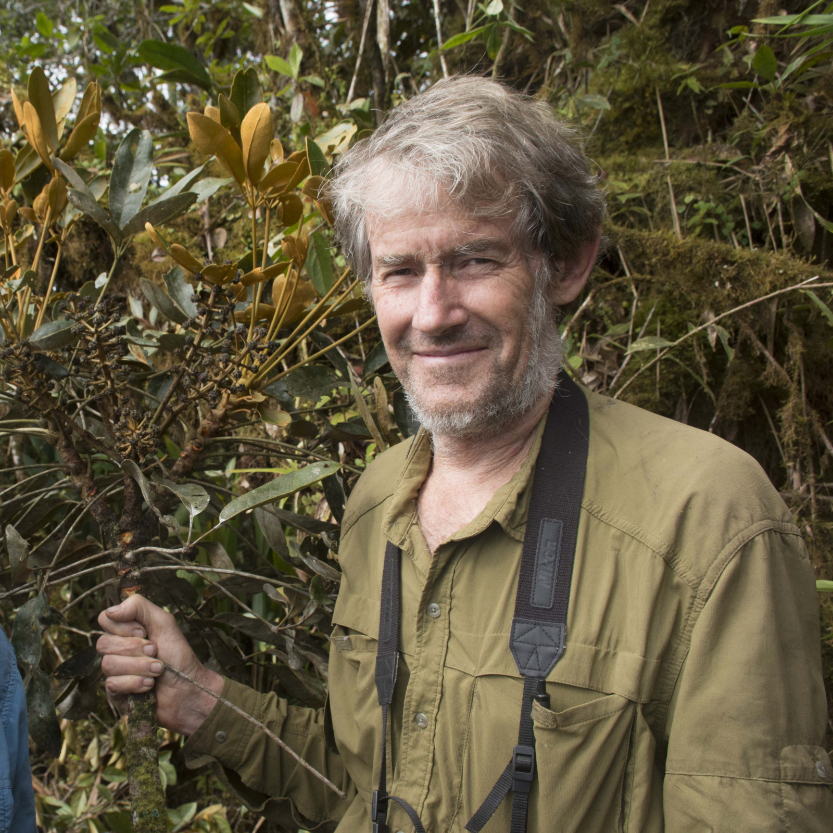 David Neill, 2019. Photo: John Clark.
From 1985 to 2010 David worked as Curator and resident botanist in Ecuador for the Missouri Botanical Garden and was Honorary Administrative Director at the National Herbarium of Ecuador (QCNE). Latterly he was Professor at the Universidad Estatal Amazónica, in Puyo, Pastaza and the Universidad Regional Amazónica IKIAM, at Tena in the Ecuadorian Amazon. A passionate advocate for both botanical science and conservation, David was co-founder and President and Executive Director of Fundación Jatun Sacha in Ecuador and, with Ecuadorian colleagues, in 1986, he established the Jatun Sacha Biological Station in Napo Province. David is widely known and respected for mentoring numerous generations of Ecuadorian and other Latin American botanists through his teaching. A considerable number of his collections were made with students, and his specimen labels are notable for their detailed and precise information, useful for understanding the ecological context in which the specimen was collected. Those of us who knew David and had the privilege of collaborating with him, always appreciated his calm, diligent, and gentle demeanour. Whilst always soft-spoken, he effortlessly commanded respect through his quiet, profound and unassuming presence.
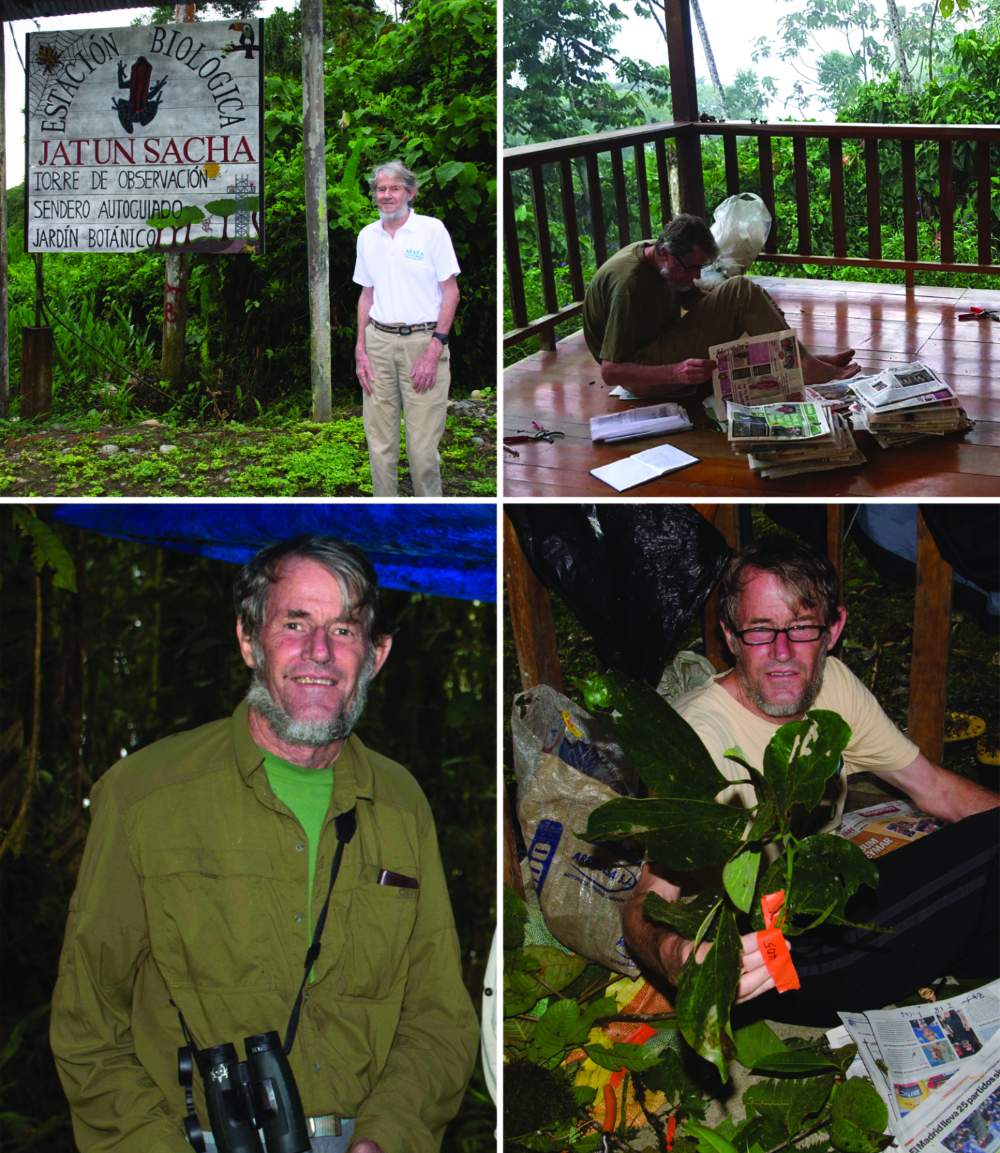 Clock-wise from top left: David at the Jatun Sacha Reserve in 2023. Pressing plants at the field station of Reserva Canandé, Ecuadorian Chocó in 2018, photo Bente Klitgaard. Pressing plants, Cordillera del Cóndor, 2014. David in the Cordillera del Cóndor, 2016. Except when mentioned, all photos by John Clark.
Although David’s botanical interests and knowledge were broad and his taxonomic work spanned various plant families, including especially Araliaceae and Magnoliaceae, throughout his career he worked on legumes and made diverse contributions to our knowledge of the family. He was lead author of the legume family for the Catalogue of the Vascular Plants of Ecuador (1999):the Libro Rojo de las Plantas Endémicas del Ecuador (2000 & 2011) and the Catálogo de las Plantas Vasculares de Bolivia (2014). That broad legume-wide taxonomic span was reflected in the new legume taxa which he discovered and described in Caesalpinioideae (Stryphnodendron porcatum & Parkia nana) and Detarioideae (Browneopsis puyensis & the new genus Ecuadendron). The genus Ecuadendron (named from Ecuador = equator in Spanish and dendron = tree in Greek) described by David in 1998 epitomises his interests in Ecuadorian trees and legumes.
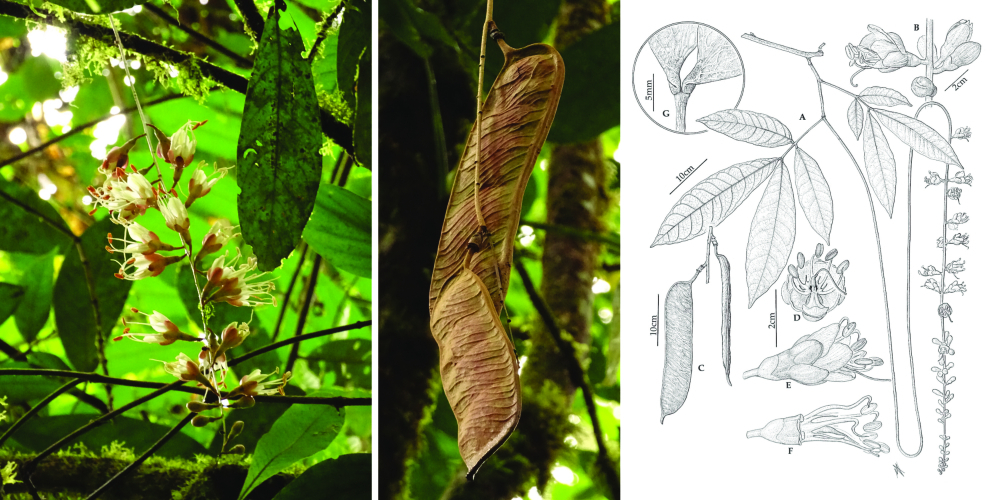 The monospecific legume genus Ecuadendron, described by David Neill in 1998, is a 30 m tall canopy tree, endemic to the Chocó rain forests of Ecuador, with long pendulous inflorescences of resupinate flowers with a rose to brick-red-coloured calyx and cream corolla, traits likely connected to bat pollination. Photos taken in the Reserva Canandé by Francisco Sornoza, Fundación Jocotoco; see also Lozano, P., Klitgaard, B., Neill, D. and Roa, L. 2022. Endemic Plants of Canandé Reserve. Field Museum field guides 1453. Drawing: John Myers.
Ecuador, where David made his home, lived for forty years, married fellow botanist Mercedes Asanza and raised their family, is a paradise for a field botanist. It is ecologically and botanically mega-diverse and in the mid-1980s when David started working there the flora was still very incompletely surveyed and known to have great scope for exploration of under-collected areas and the likely discovery of plants new to science. David conducted extensive botanical collections and surveys throughout Ecuador, from the high elevation tropical alpine páramo grasslands to the lowland tropical rainforests of the Amazon and the montane cloud forests in between. Legumes were always in his sights. For example, he made well over 100 collections of Lupinus in the páramos. From the year 2000, David pioneered the exploration of the endemic-rich Andean Tepuis-like forests of the sandstone plateaus of the Cordillera del Cóndor in southern Ecuador, where numerous new plant species are being discovered. These include the small Papilionoid legume tree, Ormosia neillii J.L.Clark & J.E.Guevara, named in 2025 in honour of David’s legume and wider botanical legacy (see New Species Highlights, this Issue of the Bean Bag).
David Neill’s Publications on Legumes
Neill, D.A. 1987. Trapliners in the trees: hummingbird pollination of Erythrina sect. Erythrina (Leguminosae: Papilionoideae). Annals of the Missouri Botanical Garden 74(1): 27–41.
Neill, D.A. 1988. Experimental studies on species relationships in Erythrina (Leguminosae: Papilionoideae). Annals of the Missouri Botanical Garden 75(3): 886–969.
Neill, D.A. 1989. A new species of Stryphnodendron (Fabaceae: Mimosoideae) from Amazonian Ecuador. Annals of the Missouri Botanical Garden 76(1): 357–359.
Neill, D.A. 1998. Ecuadendron (Fabaceae: Caesalpinioideae: Detarieae): a new arborescent genus from western Ecuador. Novon 8(1): 45–49.
Neill, D. A. 2000. Fabaceae. Pp. 196–205 en R. Valencia, N. Pitman, S. León-Yánez and P. M. Jørgensen (eds.):Libro Rojo de las Plantas Endémicas del Ecuador 2000. Publicaciones del Herbario QCA, Pontifica Universidad Católica del Ecuador, Quito.
Neill, D.A. 2009. Parkia nana (Leguminosae, Mimosoideae):a new species from the sub-Andean sandstone cordilleras of Peru. Novon 19(2): 204–208.
Neill, D. 2011. Fabaceae. Pp. 325–335. En: León-Yánez, Valencia, R., Pitman, N., Endara, L., Ulloa Ulloa, C. & Navarrete, H. (eds.). Libro Rojo de las plantas endémicas del Ecaudor (2a edición). Publicaciones del Herbario QCA. Pontificia Universidad Católica del Ecuador, Quito.
Neill, D.A., B.B. Klitgaard and G.P. Lewis. 1999. Caesalpiniaceae, Fabaceae, Mimosaceae. Pp. 368–374, 468–484, 591–601. In: P.M. Jørgensen y S. León Yánez (eds.):Catalogue of the Vascular Plants of Ecuador. Monographs of Systematic Botany from the Missouri Botanical Garden 75.
Neill, D.A. and Asanza, M., 2014. Browneopsis puyensis (Leguminosae: Caesalpinioideae: Detarieae):a new species from Amazonian Ecuador. Journal of the Botanical Research Institute of Texas 8(2): 511–516.
Neill, D.A., Romero, C., Atahuachi, M., Rico, L., Klitgaard, B., Lewis, G., Barham, J. and Vargas, E. 2014. Fabaceae. Pp. 611–704. In: Jørgensen, P.M., Nee, M. and Beck, S.G., (Eds.) Catálogo de las Plantas Vasculares de Bolivia. Monographs of Systematic Botany from the Missouri Botanical Garden 127.
Lozano, P., Roa, L., Neill, D.A., Simpson, E.N.F. y B. Klitgaard. 2024. Flora, ecología y fitogeografía de la Reserva Canandé, Chocó ecuatorial, Pp. 164. Editorial Murciélago Blanco, Quito.
Dr. Shirley Cotter Tucker: A Lifelong Passion for Plants
Vidal Mansano (Jardim Botânico do Rio de Janeiro, Brazil) and Anne Bruneau (Université de Montréal, Canada)
Dr. Shirley Cotter Tucker (1927-) stands as a towering figure in botany, whose distinguished career as a researcher, educator, and philanthropist has left an indelible mark on the field. Her journey, which began in the greenhouses of the University of Minnesota, spans over six decades of profound contribution, notably in legumes to which she dedicated a large part of her career.
From Minnesota Roots to Botanical Rigor
Daughter of plant pathologist Ralph Cotter, Shirley’s childhood was spent amidst the verdant warmth of university greenhouses–-a welcome refuge from Minnesota’s long winters that forged an early bond with plants. This passion solidified during her undergraduate and Master’s studies at the University of Minnesota, where she demonstrated extraordinary dedication by collecting over 4,000 herbarium specimens, with a focused interest in lichens.
Her pursuit of botany led her to the University of California, Davis, where she earned her Ph.D. in 1956 on the floral development of Drimys winteri, studying under the renowned plant anatomist, Dr. Katherine Esau.
A Productive Career at Louisiana State University
At LSU in Baton Rouge, Louisiana, where Dr. Tucker spent the majority of her professional life, she built a highly productive career as a professor of botany. She authored over 140 seminal papers on floral morphology and plant systematics, many focused on characterizing the complex floral development of legumes of all subfamilies and from all parts of the world. Her work, often as the sole author, was characterized by meticulous observation, frequently utilizing scanning electron microscopy to describe in detail organogenesis and organ development in diverse legumes.
 Shirley Tucker accepting the BSA’s Centennial Award in 2006 from Dr. Peter Raven. The award acknowledged and honored outstanding service to the plant sciences and the Society. Photo by Bill Dahl, Botanical Society of America.
She relished the fieldwork opportunities that Louisiana’s climate afforded, collecting plant and lichen specimens year-round. Shirley was a person greatly admired by botanists around the world, among them, the renowned Dr. Peter Raven told me in 2018: Shirley Tucker’s amazing career has so far spanned more than sixty productive years, most of which she spent mostly as a faculty member at Louisiana State University. I got to know her when we were both students in the University of California system in the 1950s, and have enjoyed her fine works on floral anatomy, lichens, and many other subjects over the years. Shirley’s charming modesty and evident pleasure in life have always made visits with her pleasant and memorable. She has given inspiration and support to so many in the course of her “retirement” years studying lichens at the Santa Barbara Botanic Garden and became a fixture of that institution. Her preserved floral anatomy collection and associated laboratory tools have been given to the Missouri Botanical Garden. Finally, her recent endowment of a professorship in botany at LSU will stand as a lasting contribution to the science she loves so much.
Although Tucker is recognized for her formidable contribution to our understanding of the complexity of flower development in legumes, she also worked on other plant families (e.g., Piperaceae, Saururaceae, Proteaceae) and all her life she remained fascinated by lichens. She returned to this passion after her formal retirement in 1995, when she moved to Santa Barbara with her husband Ken Tucker. There she continued to collect, study and publish on lichens. She donated more than 9,500 specimens of lichens to the Santa Barbara Botanical Garden and currently she has dozens of published papers on lichens.
A Philanthropic Legacy: Ensuring Botany’s Future
Following Ken’s passing in 2014, Dr. Shirley C. Tucker channeled their shared resources into a lasting philanthropic legacy dedicated to botany. This legacy provides crucial support to institutions across the United States. Major initiatives include the renaming of the LSU Herbarium as the Shirley C. Tucker Herbarium. Furthermore, the legacy funds five full-time curatorial positions, ensuring sustained expertise in the field:
A Lasting Inspiration
Even as a hand tremor led her to shift focus from delicate floral dissections to the study of lichens, her scientific drive never waned. She is now a fixture at the Santa Barbara Botanic Garden, where she mentors docents, identifies lichen collections, and continues to share her immense knowledge.
World-renowned morphologist and a generous benefactor, her journey has been one of constant growth and contribution. Her contributions also included acting as President both of the Botanical Society of America (1987–1988) and of the American Society of Plant Taxonomists (1995–1996). As one collaborator noted, a research trip with her was “one of the most significant scientific happenings of my entire career.” Through her groundbreaking research, dedicated teaching, and visionary philanthropy, Dr. Tucker has ensured that her passion for botany will inspire and support generations to come.
Shirley Tucker’s work has helped many taxonomists and phylogeneticists to find important morphological synapomorphies for different groups of Leguminosae. Among her contributions, noteworthy ontogenetic findings corroborate the segregation of Cassia, Senna, and Chamaecrista; distichous inflorescence arrangement in Dialioideae; the pentamerous base of the tetralobed calyx in many Detarioideae; and the base of dioecy in Ceratonia, among others. A selection from Shirley Tucker’s numerous important articles follows below.
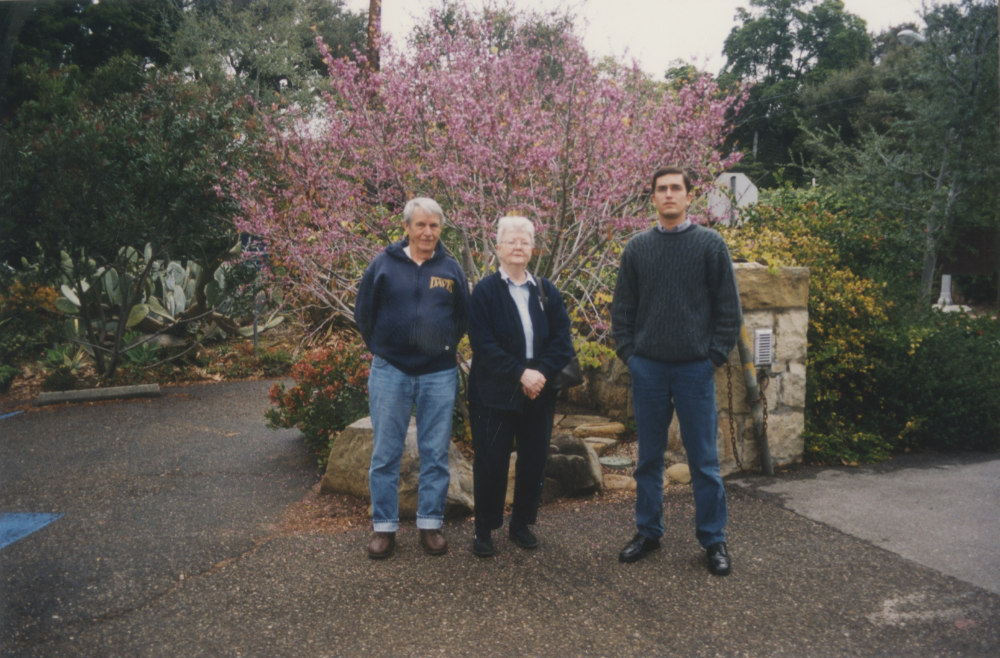 Shirley between Ken, to the left, and me (Vidal Mansano), to the right, at the Santa Barbara Museum of Natural History with a flowering Cercis tree behind us. “In 2001 during my PhD I went to Santa Barbara for two months to work with Shirley Tucker and study the floral development of some atypical Papilionoideae flowers. My first experience overseas. It was one of the most significant scientific happenings of my entire career!”
Examples of Shirley C. Tucker’s landmark contributions on legumes
Tucker, S.C. 1984. Unidirectional organ initiation in leguminous flowers. American Journal of Botany, 71(8):1139-1148.
Tucker, S.C. 1987. Pseudoracemes in papilionoid legumes: their nature, development, and variation. Botanical Journal of the Linnean Society, 95(3):181–206.
Tucker, S.C. 1989. Overlapping organ initiation and common primordia in flowers of Pisum sativum (Leguminosae: Papilionoideae). American Journal of Botany, 76(5):714-729.
Tucker, S.C. 1992. The developmental basis for sexual expression in Ceratonia siliqua (Leguminosae: Caesalpinioideae: Cassieae). American Journal of Botany, 79(3):318–327.
Tucker, S.C. 1992. The role of floral development in studies of legume evolution. Canadian Journal of Botany, 70(4):692-700.
Tucker, S.C. 1997. Floral evolution, development, and convergence: the hierarchical-significance hypothesis. International Journal of Plant Sciences, 158(S6):S143-S161.
Tucker, S.C. 1998. Floral ontogeny in legume genera Petalostylis, Labichea, and Dialium (Caesalpinioideae: Casssieae):a series in floral reduction. American Journal of Botany 85(2): 184–208.
Tucker, S.C. 1999. Evolutionary lability of symmetry in early floral development. International Journal of Plant Sciences, 160(S6):S25-S39.
Tucker, S.C. 2000. Evolutionary loss of sepals and/or petals in detarioid legume taxa Aphanocalyx, Brachystegia, and Monopetalanthus (Leguminosae: Caesalpinioideae). American Journal of Botany, 87(5):608-624.
Tucker, S.C. 2003. Floral development in legumes. Plant Physiology, 131(3):911-926.
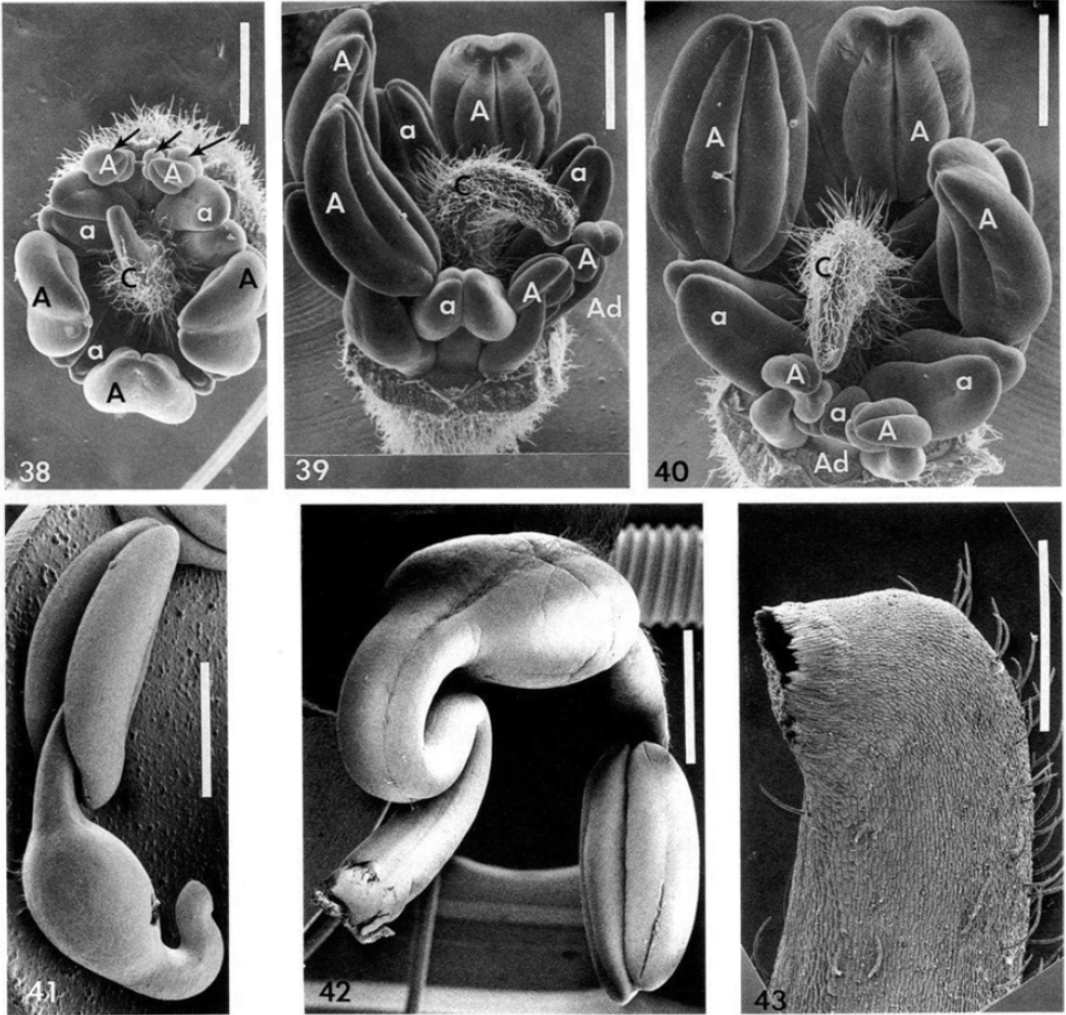
 Examples of SEM images produced by Shirley Tucker. Top panel, Cassia, bottom panel, Ceratonia.