STUDENT DIGEST
Bee Flowers with a Twist: Are Keel Flowers responsible for Papilionoideae evolutionary success?
Thiago Cobra e Monteiro (PhD candidate,
Universidade Estadual Paulista Júlio de Mesquita Filho, Instituto de Biociências, campus de Botucatu, Brazil)
What drives bursts of diversification in species-rich lineages? This question is a long-standing dilemma for biologists. Some suggest the answer relies on the combined effects of whole-genome duplications, ecological opportunity, and morphological traits (Donoghue & Sanderson 2015), while others believe species radiations may be fueled by single key morphological innovations, such as specialized pollination syndromes (Kay & Sargent 2009).
One potential key morphological innovation is the keel flower, a pollination syndrome that has evolved multiple times across angiosperms but is particularly abundant in Fabales, especially in Polygalaceae (tribe Polygaleae) and in the Leguminosae subfamily Papilionoideae (Faegri & van der Pijl 1979). Keel flowers guide bees to nectar while concealing pollen, depositing it precisely on parts of the bee’s body inaccessible to the insect (Westerkamp 1997). Because bees collect pollen to feed their larvae—which can reduce pollination efficiency—keel flowers can be viewed as “bee flowers with adaptations against bees”. They are morphologically diverse and can operate by four different mechanisms, sometimes involving secondary pollen presentation.
In an exciting study published this year, Cai et al. tested whether the evolution of keel flowers is the main driver behind bursts of diversification in Fabales. They generated a robust phylogenomic framework using 1,456 low-copy nuclear genes from 287 legume species and dated the tree with eleven fossils. This backbone phylogeny was used to constrain uncertain nodes in a larger matK phylogeny including 3,326 Fabales species. They then estimated diversification-rate shifts with Bayesian Analysis of Macroevolutionary Mixtures (BAMM). After coding species by flower type (keel vs. non-keel), they inferred diversification rates under state-dependent and state-independent speciation and extinction (SSE) models (e.g. models accounting for the correlation between keel flower evolution and bursts of diversification and models where these two variables are independent) for both their entire dataset (Fabales) and Papilionoideae only. They also conducted a phylogenetic ANOVA to compare tip rates between keel and non-keel species and inferred keel flowers evolution with ancestral state estimation.
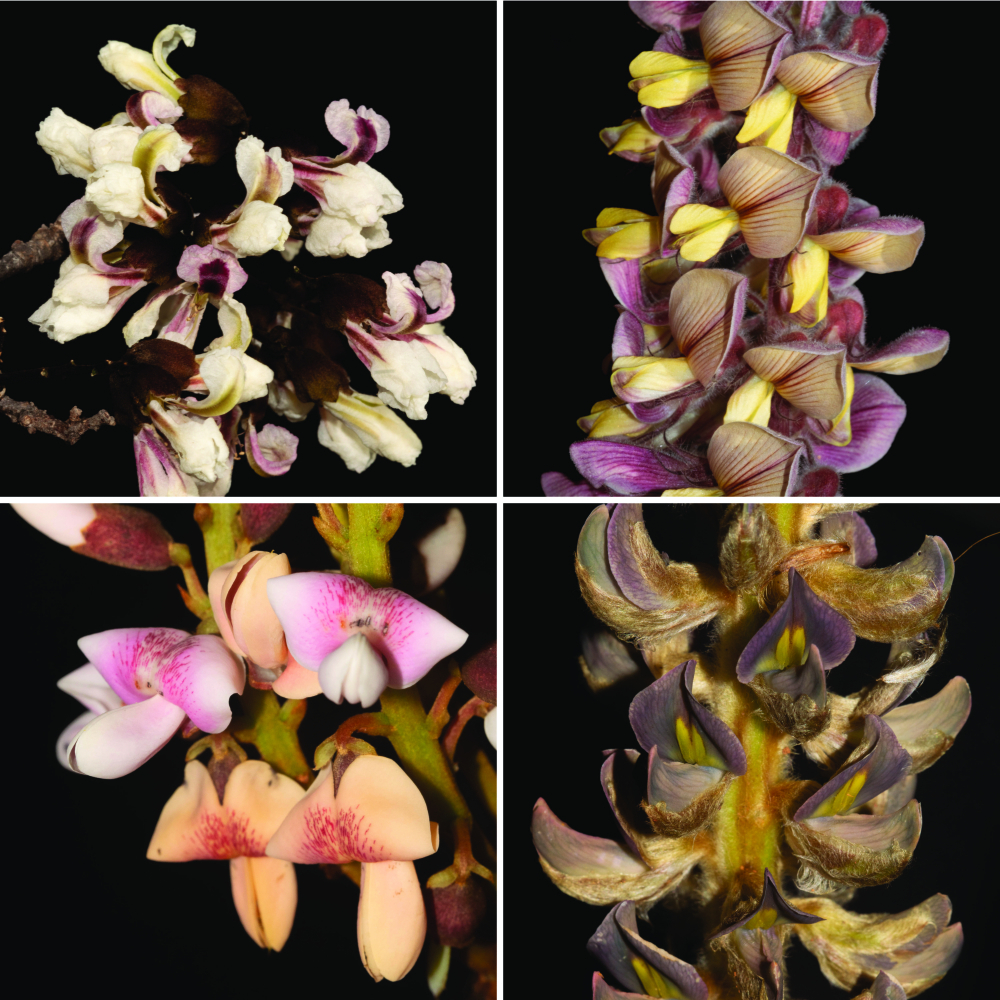 Diversity of shapes and colors in Papilionoideae keel flowers. Clockwise from top left. Luetzelburgia andrade-limae H.C.Lima. Eriosema defoliatum Benth.. Lupinus paraguariensis Chodat & Hassl. Hymenolobium heterocarpum Ducke. Photos by Thiago Cobra e Monteiro.
Cai et al. identified 18 diversification-rate shifts across Fabales, 11 within Papilionoideae—nine during the Miocene, a period of global climatic change. Ancestral state reconstruction supports six independent origins of keel flowers, including near-simultaneous origins in Polygaleae and Papilionoideae around 60 Mya. This finding challenges previous estimates placing the origin of keel flowers of Papilionoideae ~20–10 million years before those of tribe Polygaleae (Uluer et al. 2022). They also detected 32 independent losses of keel flowers, most (28) in early-diverging papilionoid lineages. Together, these results suggest that ancestral Fabaceae and Papilionoideae as a whole likely had a more generalist pollination system, with flexible floral symmetry and petal number. Over time, ecological pressures and developmental canalization may have produced the conserved papilionoid floral form widespread in the Non-Protein Amino Acid-Accumulating (NPAAA) clade.
Importantly, trait-independent diversification models provided a better fit to the data, overturning the idea that keel flower evolution alone triggered major radiations. In this context, the authors suggest more complex scenarios in which multiple factors, such as nodulation, ecological opportunity, whole-genome duplications, and floral innovation, may have acted together to promote diversification.
Papilionoideae shows remarkable floral diversity, and even closely related genera can differ substantially in flower morphology and pollination mode (Monteiro et al. 2025). Although future research is needed to fully uncover the developmental and ecological drivers underlying this diversity, Cai et al.’s study is a major contribution towards understanding the evolution of keel flowers.
References
Cai, L., Cardoso, D., Tressel, L.G., Lee, C., Shrestha, B., Choi, I., Lima, H.C., Queiroz, L.P., Ruhlman, T.A., Jansen, R.K. & Wojciechowski, M.F. 2025. Well-resolved phylogeny supports repeated evolution of keel flowers as a synergistic contributor to papilionoid legume diversification. New Phytologist 247: 369-387. https://doi.org/10.1111/nph.70080
Donoghue, M.J. & Sanderson, M.J. 2015. Confluence, synnovation, and depauperons in plant diversification. New Phytologist 207: 260-274. https://doi.org/10.1111/nph.13367
Faegri, K. & van der Pijl, L. 1979. Principles of Pollination Ecology, Third Edition. Oxford: Pergamon Press. https://doi.org/10.1016/c2009-0-00736-3
Kay, K.M. & Sargent, R.D. 2009. The role of animal pollination in plant speciation: integrating ecology, geography, and genetics. Annual Review of Ecology, Evolution, and Systematics 40: 637-656. https://doi.org/10.1146/annurev.ecolsys.110308.120310
Monteiro, T.C., Falcão, M.J., Mansano, V. & Fortuna-Perez, A.P. 2025.** Unraveling floral ontogeny and evolutionary trade-offs in the Adesmia clade (Dalbergieae, Papilionoideae, Fabaceae). Botanical Journal of the Linnaean Society, boaf104. https://doi.org/10.1093/botlinnean/boaf104
Uluer, D.A., Forest, F., Armbruster, S. & Hawkins, J.A. 2022. Reconstructing an historical pollination syndrome: keel flowers. BMC Ecology and Evolution 22: 45. https://doi.org/10.1186/s12862-022-02003-y
Westerkamp, C. 1997. Keel blossoms: Bee flowers with adaptations against bees. Flora 192: 125-132. https://doi.org/10.1016/S0367-2530(17)30767-3